



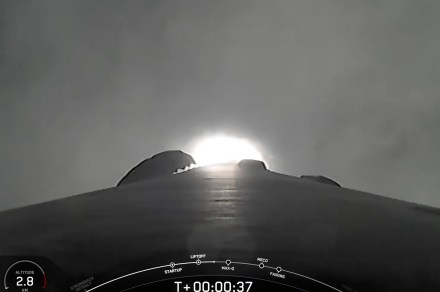
A SpaceX Falcon 9 rocket has flown straight into the record books after launching and landing a record 26 times.
Booster 1067 launched from Cape Canaveral in Florida on Saturday, delivering 21 Starlink satellites to low-Earth orbit. About eight minutes after liftoff, the first-stage booster landed on the droneship A Shortfall of Gravitas in the Atlantic Ocean. SpaceX shared footage of the booster completing the record-setting 26th flight.
Falcon 9 lands on the A Shortfall of Gravitas droneship, completing the first 26th launch and landing of an orbital class rocket pic.twitter.com/x18IxIGtNk
— SpaceX (@SpaceX) February 15, 2025
Please enable Javascript to view this content
The booster previously launched CRS-22, Crew-3, Turksat 5B, Crew-4, CRS-25, Eutelsat HOTBIRD 13G, O3B mPOWER, PSN SATRIA, Telkomsat Marah Putih 2, Galileo L13, Koreasat-6A, and now 15 Starlink missions. Having landed safely on the droneship, the booster can now be refurbished and flown again.
SpaceX has been consistently pushing the boundaries of rocket reusability, with multiple Falcon 9 boosters now having completed more than 10 flights. The system, refined by SpaceX over the last decade, drastically cuts the cost of spaceflight as it eliminates the need to build a new booster for each mission.
In a more ambitious move, SpaceX is now developing the mighty Starship rocket with a view to reusing both the upper-stage Starship spacecraft and the first-stage Super Heavy booster.
To date, SpaceX has performed seven test flights of the Starship, which is the most powerful rocket ever to fly. Taking what it’s learned from the Falcon 9 system, engineers have designed a similar descent technique to bring home the Super Heavy soon after it’s deployed the Starship to orbit. But whereas the Falcon 9 touches down on a droneship or on the ground, the Super Heavy is secured by two mechanical arms on the launch tower before it touches the ground. It’s a spectacular feat that has to be seen to be believed.
The Starship spacecraft is also designed to land after flight, whether back on Earth or on another celestial body, with SpaceX aiming to test the procedure in an upcoming flight.
NASA and SpaceX are planning to use the Starship for crew and cargo missions to the moon, Mars, and beyond, with a modified version of the spacecraft set to transport two NASA astronauts to the lunar surface in the Artemis III mission, currently scheduled for 2027.
Not so many moons ago, Trevor moved from one tea-loving island nation that drives on the left (Britain) to another (Japan)…
SpaceX preps the mighty Starship rocket for its 8th flight test
Activity at SpaceX’s Starbase site in Boca Chica, Texas, suggests that the spaceflight company is moving rapidly toward the eighth test of its mighty Starship rocket, which comprises the first-stage Super Heavy booster and the upper-stage Starship spacecraft.
SpaceX has released two sets of images from the site in recent days, the first one showing the Super Heavy booster being transported to the launchpad:
Read more
SpaceX’s Starship explosion caused flights to change course
SpaceX performed the seventh test flight of the Starship rocket on Thursday, but the upper-stage uncrewed Starship spacecraft blew up in midair soon after separating from the first-stage Super Heavy booster.
Footage of the debris falling over the Caribbean started to show up on social media, with SpaceX boss Elon Musk posting that “entertainment is guaranteed” with each Starship launch.
Read more
Watch SpaceX’s Starship spacecraft crash to Earth
SpaceX nailed the landing of its first-stage Super Heavy booster during the seventh test of its mighty Starship rocket on Thursday, but the upper-stage Starship spacecraft suffered what SpaceX likes to call a “rapid unscheduled disassembly” (in regular-speak, it blew up) soon after stage-separation.
A short while later, clips started appearing on social media apparently showing bits of the uncrewed Starship falling back to Earth near the Turks and Caicos Islands about 1,600 miles (2,600 km) east of the rocket’s launch site near Boca Chica, Texas. SpaceX chief Elon Musk reposted one of them, saying: “Success is uncertain, but entertainment is guaranteed!” However, it was later reported that the FAA had to divert a number of flights in the area to ensure aircraft were kept away from the descending debris. It’s also currently unknown if any of the debris reached land or if all of it landed in the sea.
Read more