



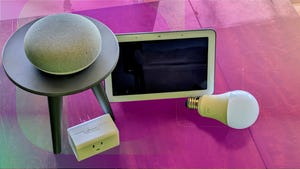
Are you a fan of all things Google, including smart home tech? Google’s Home app (recently revamped) is an excellent choice for your smart home, and the latest devices like Nest cameras have advanced Gemini AI technology. Plus, a full range of devices from smart speakers and displays to thermostats and smoke detectors work with the Google Home app. This lets you control everything from one platform, including all the app notifications you receive.
Best Google Smart Home Devices in 2025: Gemini and Home App Support
Best smart display for Google
Best security camera for Google
Best smart speaker
Best smart thermostat
Best battery camera for Google
Best security camera with light for Google
Best home security system for Google
Best smart lock for Google
Best video doorbell for Google
Best smart light for Google
Best smart plug for Google
Best smoke detector for Google
Best leak detector for Google
Holiday buying advice for Google smart-home devices
Below, I’ve gathered the best smart devices for Google that I and other CNET reviewers have tested. They’re winning add-ons if you’re looking to expand your home system on your terms. If you’re looking to give a smart device as a gift to a Google user, it’s best to start with my guide on the best smart home gifts first.
Read more: 6 Settings That Make Nest and Google Devices 100x More Useful
Pros
Larger 10-inch screen is great for viewing photo albums, watching Netflix, etc.
Voice assistant options combine well with on-screen device cards and command confirmations
Can browse the internet for quick guides or answers
Great device to start morning or evening routines
Cons
Expensive compared to smaller Nest hubs
The Google Nest Hub Max is a great way to kick off a Google-centric smart home. The Hub can, like the Google Home app, control other connected smart devices on my list and gives you immediate access to Google’s voice assistant for questions, Calendar updates, lists and other tricks, all supported by the 10-inch adaptive brightness touchscreen.
Smart displays like the Hub Max can act as desktop assistants, mini TVs (including support for Netflix) or kitchen helpers, depending on what you need and how you position the screen. They also make building routines easy with basic commands like, “Hey Google, good morning!” to begin with weather, traffic, news, music and more. The sound is also good enough for the Hub Max to serve as a music player for a small room, and the camera supports quick video chats as well.
The UI isn’t quite as intuitive as Amazon’s Echo line, but it’s serviceable and will be familiar to those who’ve already used the Google Home app. Plus, the latest Gemini for Home upgrades can help make voice controls even easier, so you may not do much swiping. If this large version seems like too much money, you can still get a smaller Nest Hub 2 for around $100.
Pros
Compact design
Higher 2K resolution
Can enable all of Gemini for Home’s advanced features
Cons
Wired only
Fisheye lens view takes a little getting used to
Nest’s third-generation cams are all wired, which makes them less feasible for outdoor use but still a strong choice for an indoor camera. They’re also more compact, have a higher 2K resolution and come ready for all kinds of Gemini for Home shenanigans. I’ve tested these cameras thoroughly, and I like everything they can do, albeit with a somewhat fish-eyed lens used to capture as broad a view as possible.
If you’re willing to shell out $20/month for the top-tier Google Home Premium subscription (Nest Aware is no longer a thing), then you can get AI analysis of all your video clips, complete with descriptions, daily summaries of what happened and other time-saving information. It’s a powerful package for very thorough security. If you do have a protected outdoor outlet, you could choose the outdoor version instead.
Pros
Affordable speaker at $50
Easy access to Google’s voice assistant options
Wall mountable
Great desktop add-on for scheduling and more
Cons
The tiny speaker doesn’t produce audio equal to any larger smart speakers
Google is planning to release a new smart speaker in 2026, which will almost certainly take this spot in the future. But for now, I’m recommending the extra-affordable Nest Mini.
Google’s small smart speaker is now in its second generation and offers voice assistant capabilities, with many Gemini for Home features backward compatible with this model. It also has helpful extras like intercom functionality and stereo pairing with multiple Minis. You can also control compatible gadgets, search the web, play music and use its other features just by asking. The audio quality of the Nest Mini is surprisingly good, especially in this second-gen model, as long as you keep it short range, like on a desk.
At $49, this is one of the least expensive ways to try smart home features without sacrificing voice control. The Nest Mini is also a good secondary device. If you put a Google Nest Hub in your kitchen, you can put a Nest Mini in a different room, and both will be able to control any compatible smart devices you set up. Even if they both hear you, only the closest one will respond.
Pros
Room sensor included
Smart schedule adjustments
Beautiful design
No C-wire required
The Nest smart thermostat has been a mainstay in the smart home world for years, and in 2024, we finally got a new Nest Learning Thermostat (4th Gen), which works exceptionally well. It is on the expensive side, but the thermostat’s overall design is stunning, with a large display that mimics weather conditions.
Sensors and intelligence also enable the thermostat to learn and adjust your climate preferences over time to keep you comfortable and save money. It integrates perfectly within the Google Home ecosystem with remote temperature sensors, one of which is included in the box, to help monitor climate and activity in the home.
Installation is a breeze, and it can be installed in nearly any home since it doesn’t require a C-wire, which is typically needed to work with some older homes or HVAC systems.
Pros
Google’s great AI detection
Free cloud video storage
Magnetic base for easy charging
Google Assistant and Alexa support
Cons
Resolution could be higher for the price
As I mentioned, Nest does have a 3rd-generation outdoor camera, but it’s wired only and that’s a pretty severe restriction for placing outdoor cameras, requiring a nearby outlet. I still prefer this battery model for far more versatile options.
While it’s a bit larger, this Nest cam has an effective magnetic base that lets you pop the cam off or quickly reposition it. It’s native support for Google Home is welcome, and while the 1080p resolution isn’t as high as the 3rd gen, it’s fine for basic viewing indoors or out.
Additionally, the Nest Cam offers three free hours of cloud storage with no subscription required (upgraded to six hours if you do choose a wired model). Second, like many top cams, the Nest Cam has object detection for people, packages, vehicles and animals, but it doesn’t charge extra for it, only for more advanced AI detection, so you still get a lot for no additional cost.
Pros
Powerful, customizable LED lights
Mountable battery cam attachment is versatile
Has the useful Nest extras like free storage
Lots of settings options
Cons
The junction box requirement needs wiring work and the compatibility with your current light switch can be unpredictable
I like many different floodlight cameras, but Google’s Nest cam model is one of my favorites. The LED lights are very bright but also highly customizable, so you can set the brightness and motion activation to what works best for you, as well as adjusting lights to the right angles.
The cam model on this is the same 2nd-gen battery camera from my other Nest recommendation with all the same benefits. That includes free cloud storage for a few hours, basic object recognition, motion zone setting and so on.
Note that this camera does require a junction box to work, which usually means working on a ladder and handling at least three wires. Your connected light switch may behave a bit differently when you’re done, but again, there are many settings in Google Home to play with that can help out.
Pros
Designed to work with Google Home
Allows for complex security routines
Offers DIY options to save money and time
Reliable, upgraded sensors
Cons
ADT retains its expensive, required contracts, which is frustrating if you want to save money
ADT’s integration with Google Nest is complete with the 2024 arrival of ADT Plus, a new version of ADT’s home security system that’s built from the ground up to work with Google Home, Nest devices and Google Assistant. You can control your Nest devices using Google Home or the ADT Plus app. ADT Plus can also use Nest’s familiar face technology for its Trusted Neighbor passes, which can unlock a smart lock when the Nest Doorbell recognizes a family member or pet sitter.
ADT’s kit has also received a minor revamp, making sensors more compact than ever. Displays like the Nest Hub Max also work well with the system. ADT’s required subscription starts at $25 a month (but builds up quickly from there), which includes one base, four door/window sensors, a motion sensor, and four stickers. A contract is required for this one.
Pros
Comes in several designs
Durable keypad
Options for sharing access codes
Built-in Wi-Fi
Compatibility with ADT and familiar face technology
Cons
Expensive
No built-in fingerprint scanning
Yale’s Assure 2 lock gets my vote for two reasons. First, it’s already near the top of my best smart lock list, as a well-rounded lock with a few different design options and plenty of compatibility, including Google Home. Remember how ADT’s latest system works so well with Google? Yale’s Assure 2 has similar compatibility, offering tricks like using Google’s familiar face recognition to see family members and automatically unlock the door.
Even without these more advanced tricks, a smart lock like Yale’s is incredibly useful, offering app unlocking a keypad and the ability to give access codes or passes to others. You can set it to auto-lock if left unlocked and control it remotely no matter where you are. Finally, it’s simple enough to install on your own and you don’t need an extra hub to add Wi-Fi.
Pros
Battery model for easy placement
Reasonably affordable around $120
Three free hours of video storage
Free object detection for packages and more
Cons
Resolution is a bit low
Once again, Nest has a third-generation doorbell with better resolution and more Gemini features, but that wired requirement is particularly annoying here. Not everyone (including me) has a wired doorbell that faces in a direction to give the camera a good view, and a battery model gives you so many more options for placement that it’s easy to recommend this 2nd-gen doorbell instead.
Fortunately, everything else about this doorbell holds up well, including Nest benefits like object recognition for free — which is especially handy for recognizing packages — and a few hours of free video storage. The resolution isn’t especially high, but it has a good field of view for your front door, and I’ve never been troubled by a lack of detail when using mine.
Pros
Very affordable
Scheduling and motion sensing options
Color version available
No hub needed
Cons
Won’t work well in floodlight sockets
Wiz is a smart lighting brand that’s greatly improved its products and features over the past few years. The smooth and consistent connectivity, affordability and Spacesense motion sensor make these lights stand out from others.
Connecting these lights to your Google Home system is as easy as following a few prompts in the app. Once connected, you get all the expected features of smart lights, including remote control from anywhere with an internet connection, brightness controls, scheduling, automations and more. Spacesense, meanwhile, helps with noninvasive motion sensing that can also turn lights on and off.
Wiz bulbs are also especially cheap and don’t require a hub to use. You can upgrade to a color version if you want even more choices for control.
Pros
Compact
Cheap
Easy to use
Cons
No energy monitoring
A smart plug is a great way to efficiently add connectivity to dumb devices. Plug in a lamp or fan, and you’ll be able to control it with an app. The TP-Link Kasa Smart Plug offers smartphone app controls and Google compatibility. Plus, the design is compact and doesn’t block adjacent outlets.
It won’t monitor energy, but the smart plug lets you control an old-fashioned floor fan or lamp with your voice for a very reasonable price. Like most smart plugs, it works with a 2.4GHz Wi-Fi network connection.
Pros
Built-in compatibility with Google
Useful remote alerts
Detects smoke and carbon monoxide
Google once had its own smoke alarm, the Nest Protect, but this model was cancelled in 2025. Fortunately, Google replaced it with a partnership with highly reliable fire safety brand First Alert. Now, this smoke detector detects both smoke and carbon monoxide and can fully integrate with Google’s Home app. That means you get warnings on your phone even if you aren’t at home, as well as early notifications that you should replace your batteries.
There’s a wired version of this alarm as well in case you have to meet certain fire code requirements, but I chose the battery version for its versatility — even if it does cost more than the average smoke alarm.
Pros
Affordable
No hub needed
Easy to set up
Fits in many places
Cons
Harder to connect to Google Home than other picks
Leak detectors sit under your sink, toilet, water heater, washing machine and other places, waiting to detect pooling or dripping water. Then they shoot an alert to your phone and sound a siren so you can take action fast. This SwitchBot model is one of my favorites, since it’s affordable and doesn’t need a hub to work. Connecting to Google Home via Google’s supported partner options takes a few minutes, but then you can view the leak sensor alongside your other devices.
Holiday discounts are a good time to pick up Google smart-home devices as they are a great way for first-time smart home users to get into the ecosystem. Many devices make for thoughtful gifts for tech lovers and offer both convenience and automation — as long as they prefer Google instead of other voice assistants like Alexa and don’t mind skipping features like advanced video descriptions unless they’re willing to pay a high subscription. (When in doubt, just ask.) Look out for bundle offers like this incredible deal on this three-pack of Wiz Connected smart bulbs that can drive prices down, or pair them with other handy technology.