



ZDNET’s key takeaways The Asus Zenbook Duo is on sale now for $1,499 at Best Buy. This laptop is a creator’s dream machine, with dual-OLED touchscreens, a highly configurable form factor, and a great battery. It takes time and effort to get the most out of this laptop, and you’ll need lots of desk space to utilize the different form factors. $1,499.99 at Best Buy$1,499.99 at B&H Photo-Video$1,759 at Amazon
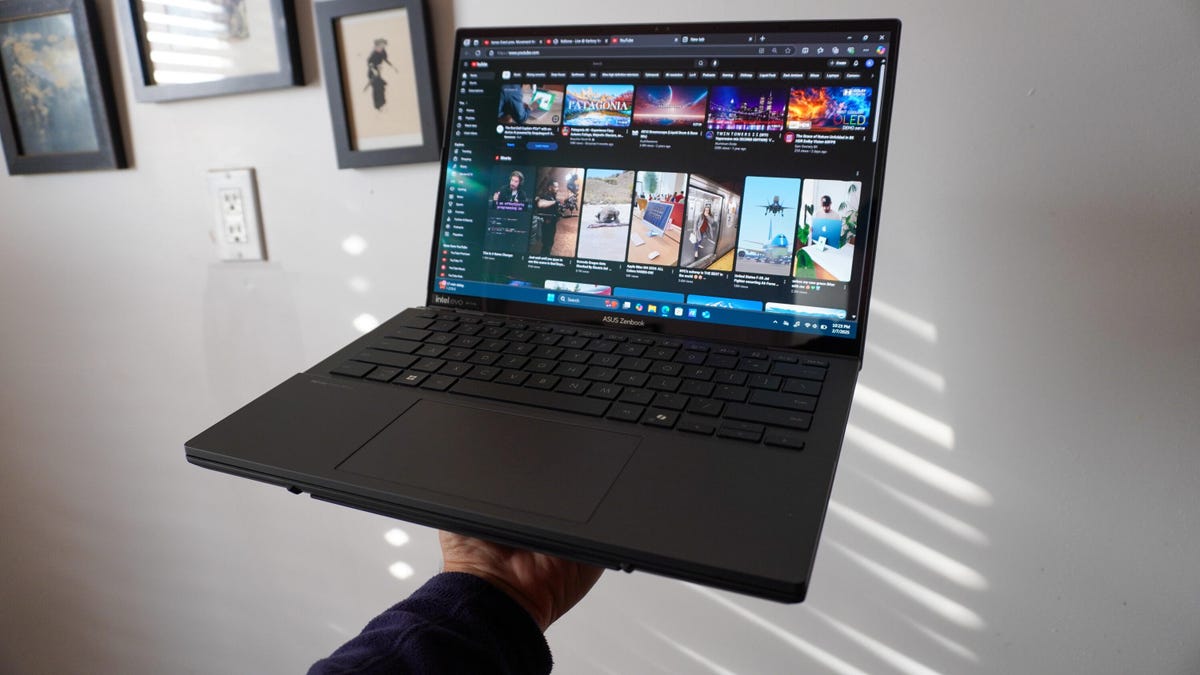
Upon first glance, Asus’ Zenbook Duo looks like a standard laptop. The first thing you’ll probably notice is the brilliant 3K OLED display, but there’s more than meets the eye here. The entire keyboard comes off to reveal a second — just as flashy — display beneath.
The Zenbook Duo is designed to challenge the laptop status quo in every way. Its dual-touchscreen form factor allows for a myriad of configurations that would otherwise not be possible with a traditional clamshell, and when paired with Asus’ rich customization features, makes for an exceptionally versatile device.
Also: I tested Asus’ 27-inch TV-monitor hybrid for two weeks – and can’t stop thinking about it
That being said, this is a laptop designed specifically for creatives, as the dual displays steal the show and fuel its visual-first use case. Its sheer flexibility allows it to adjust to work as a mobile workstation for content creators, a sketchpad for visual artists with the included stylus, or a business device that can fold down flat to display one of the two screens to a client.
This laptop has a lot going on, so let’s look at the specs. In terms of hardware, the Zenbook Duo is pretty stacked. It comes with 32GB of RAM, 1TB of storage, an Intel Arc GPU, and an Intel Core Ultra 9 (Series 2) processor, one of this device’s biggest call-outs.
Also: Finally, a powerful Windows laptop that rivals the MacBook Pro (and has a better display, too)
Intel’s Series 2 chips have proven to be battery-efficient and high-performing enough to set themselves apart, and I noted as such in my review of the Asus’ Zenbook S 14 with the Core Ultra 7 200V (Series 2) processor last year.
Kyle Kucharski/ZDNETThe chip on that laptop enabled a thinner, lighter form factor, ran cooler, and had a fantastic battery life, so I was excited to test it out the new Zenbook Duo. My initial conclusions prove that the performance is just as good; the Duo runs quiet and cool (considering the hardware), and the battery life is solid — especially for a laptop with two OLED screens.
The dual 14-inch 3K (2880 x 1800) Lumina OLED touch displays light up to 500 nits of brightness and communicates everything you need to know about this laptop. They both feature 120Hz refresh rates and the thin bezels on both make for a dramatic look, especially when the device is fully extended.
In laptop mode, the detachable keyboard covers the second screen, which has an auto-positioning magnet and pogo pins on the bottom. I appreciate that no special action is required to attach or remove the keyboard; it just snaps in place without any matching up of components.
The same goes for swapping configurations. Turning the laptop on its side flips the display orientation, and removing the keyboard activates its Bluetooth connectivity. This is a big plus, in my opinion, as users will appreciate how the laptop “understands” what you’re trying to do and adjust accordingly.
Also: I recommend this high-end laptop to creative pros over MacBooks – and it’s on sale at Best Buy
The kickstand on the back of the device enables this variety of configurations. It’s solid and sturdy, snaps into place without any fuss, and slides back down to lay flat when not needed. The only thing is that its degree of extension is rather high, meaning you won’t be able to get just a slight elevation; the Duo wants to be propped up at a 40-70-degree angle.
The Duo’s touchscreens are responsive whether you’re using your finger or the included stylus, although I personally prefer the latter to avoid fingerprint smudges. Similarly, the virtual keyboard is quite responsive, even though I tend to avoid using these any further than I must; there’s always a bit of a learning curve in how fast you can type on it.
Kyle Kucharski/ZDNETAsus has been focusing on customizability for its creative-oriented laptops, and the Zenbook Duo is no exception. In addition to the ability to set custom gestures, users can configure the buttons on the stylus, set task groups, pin apps to different displays, and arrange their apps’ windows in the display.
Instead of manually dragging apps from one window to the next, you can “flick” the top of the window to snap it in place in the desired window. This takes a minute to get used to, as dragging windows around can result in apps that are half in one display and half in the other.
Also: How to clear the cache on your Windows 11 PC (and how it helps your system run better)
As with any device with a complex range of customizations, there are certainly quirks and adjustments regarding how to best use it, especially if you’re not fully familiar with how to navigate all the options. Windows or apps can frequently be banished to another window, get lost behind other apps, or get stuck halfway.
I also had some concerns with the logistics of putting an OLED display on the same part of the laptop’s body that houses the CPU and memory. Conventional wisdom would imply that this would be a recipe for extreme heat, but Asus designed the device with this in mind, avoiding any direct contact with the components and separating them with a heat spreader.
Kyle Kucharski/ZDNETThis means the CPU is actually located on the opposite side of the motherboard, with gaps in between to facilitate airflow. In my testing, I couldn’t get the laptop to heat up to any notable degree, but it can run warm if you push it over a sustained period of time, especially if it’s plugged in. Luckily, this only happens if both displays are in use, and if that’s the case, it necessarily won’t be on your lap.
I also wish there were an option to upgrade the GPU beyond the Intel Arc it comes with, but the Intel Core Ultra 9 does so much of the heavy lifting here that it might not be necessary. Also, the design logistics probably inhibit the addition of a graphics card in what is already a packed chassis.
Also: I tried Lenovo’s infamous ‘rollable’ laptop at CES – it’s more practical than I thought
Asus advertises over 13 hours on one charge, and I found this to be more or less accurate in my testing, assuming you’re talking about video playback or normal, intermittent use throughout the day. Just keep in mind that this device will give you extreme variation in battery life times, depending on how you use it.
Kyle Kucharski/ZDNETHowever, the battery didn’t burn itself into the ground the way I assumed it would in my testing, even when I really pushed it, running some demanding video editing tasks, using both displays with full brightness while connected to an external monitor. Yes, I got a lot less juice out of it, but still managed over five hours.
ZDNET’s buying adviceThe Asus Zenbook Duo is a laptop for creatives who crave something different and want to shake up the status quo. The myriad of configurations requires a learning curve to activate and use regularly, but they are rewarding in their ability to push creative tasks to new productivity levels.
Even better is the fact that the hardware on board is solid, regardless of its physical form. The cherry on top is that it comes with a stylus and carrying case, rounding out the package for a very accessible sale price of $1,299.
I would recommend this laptop to creatives who are committed to using it the way it is designed: activating the dual displays, switching up the configurations, grabbing the stylus, and exploring new avenues of productivity. If these things don’t excite you, I would recommend a creative-minded laptop with a more traditional form factor, like the Asus ProArt P16 or the MacBook Pro M4.
Featured reviews