



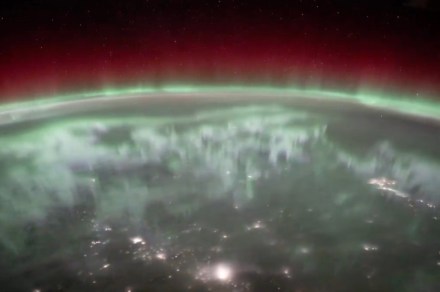
One of the highlights for astronauts who spend time aboard the International Space Station (ISS) is the chance to enjoy breathtaking aurora from some 250 miles above Earth.
The space station’s X account has just shared some stunning footage showing an aurora captured by a camera on the ISS as it traveled over Canada, from west to east.
The space station on Jan. 4 soared into a stunning aurora dancing over Canada with city lights dotting the landscape below before orbiting into a sunrise 259 miles above the Atlantic Ocean. pic.twitter.com/xhBJPZm5rm
— International Space Station (@Space_Station) February 9, 2025
Please enable Javascript to view this content
An aurora — also known as the Northern Lights (aurora borealis) in the northern hemisphere, and Southern Lights (aurora australis) in the southern hemisphere — is a natural display of light in the sky, most often seen in high-latitude regions.
The beautiful phenomenon comprises dynamic patterns of brilliant light that appear as curtains, rays, spirals, or dynamic flickers covering much of the sky.
They’re caused by disturbances in the Earth’s magnetosphere as it interacts with solar winds, with the dramatic effect the result of collisions between fast-moving electrons from space and the oxygen and nitrogen in Earth’s upper atmosphere.
Astronauts on a regular six-month mission at the space station are likely to see plenty of aurora events, so long as they’re looking out of the window as they fly over it.
The best place aboard the ISS to see an aurora is from the Cupola, a seven-window module offering panoramic views of Earth and beyond.
While the ISS has a number of Earth-facing cameras fixed to the outside of the facility that are constantly tracking events down below, astronauts with a keen photographic eye also enjoy using the station’s professional cameras and lenses to try to capture aurora. Current ISS astronaut Don Pettit, for example, recently shared his own footage of one of the light shows.
Retired Canadian astronaut Chris Hadfield once offered his own take on the spectacular occurrence, saying: “To look at the Northern Lights is like magic. To be in them, to surf on them, that’s beyond magic. It’s surreal.”
Not so many moons ago, Trevor moved from one tea-loving island nation that drives on the left (Britain) to another (Japan)…
Astronaut’s first photo of 2025 is a real stunner
NASA astronaut Don Pettit has started 2025 with a stunning Earth photo that he described as a “New Year’s light show.”
Pettit captured the amazing image from the International Space Station (ISS), where he’s been living and working since September in his fourth trip to space.
Read more
With 16 sunrises a day, when does it become 2025 on the space station?
Life on the International Space Station (ISS) is anything but ordinary. The microgravity conditions mean you spend most of your time floating around the place, and the views from the windows are special, to say the least. Popping outside requires donning protective clothing, and going to the bathroom is a more complicated process than back on terra firma.
And due to the ISS orbiting Earth at around 17,000 mph, astronauts stationed there witness 16 sunrises and 16 sunsets in every 24-hour period. So how will the current crew — NASA astronauts Suni Williams, Butch Wilmore, Don Pettit, and Nick Hague, together with Russian cosmonauts Aleksandr Gorbunov, Alexey Ovchinin, and Ivan Vagner — know when to celebrate the arrival of 2025?
Read more
This astronaut took an astonishing number of photos during his 2024 mission
If Matthew Dominick ever offers to show you his travel photos, just confirm with him first that he’s edited them down from the half a million pictures that he took during his trip into space.
Yes, that’s how many images the NASA astronaut captured during his six-month stay aboard the International Space Station (ISS), which ended in October.
Read more